Insurance and Safety for Commercial Waste Elephant and Castle
Commercial Waste Elephant and Castle is committed to operating as a fully insured rubbish company and maintaining the highest standards of safety for clients, the public and our teams. Our approach combines comprehensive insurance cover, rigorous staff training, consistent use of personal protective equipment and a structured risk assessment process. This page outlines the core elements that make an insured waste removal company reliable and safe for all kinds of commercial rubbish collection projects.Public Liability Insurance: Protection for Clients and the Public
As a professional insured waste removal company, we carry substantial public liability insurance to protect against accidental injury or property damage that could occur during rubbish collection and commercial waste handling. Public liability is a critical part of our risk management, ensuring that clients are not exposed to financial liabilities arising from everyday operations. We maintain policies with limits appropriate to commercial contracts and high-risk sites.
What Public Liability Policies Cover
Our public liability cover for an insured commercial waste company typically includes:- Third-party bodily injury arising from collection activities
- Damage to client property, stored items or fixtures during removal
- Legal costs associated with defending valid claims
- Accidental pollution and contamination incidents where relevant
Staff Training: The Foundation of a Safe Rubbish Service
A truly insured refuse company invests in people as well as policies. Our teams undergo detailed induction and continual development programmes that prioritise safe working practices, regulatory compliance and customer-focused service. Training ensures staff understand how insurance, safety and day-to-day operations interact to reduce risk.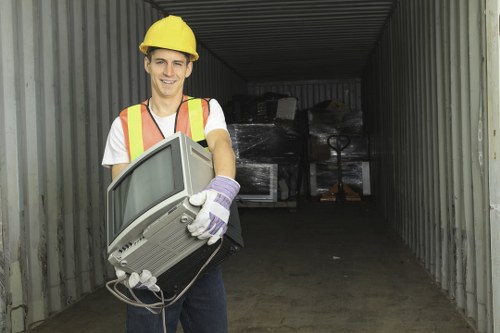
Core Training Modules and Competency Checks
We operate defined training paths to make sure every operative is confident and competent. Key modules include:- Manual handling and lifting techniques to reduce musculoskeletal injuries
- Waste classification and segregation for legal disposal
- COSHH awareness where hazardous substances are encountered
- Vehicle loading, securement and road safety for collection crews
- Incident response and first-aid basics
Competency is confirmed through assessments, practical observations and periodic refresher training to match evolving legislation and client site requirements.
Personal Protective Equipment (PPE)
Wearing appropriate PPE is non-negotiable for any insured rubbish removal service. We provide and enforce use of:- High-visibility clothing for roadside and busy site operations
- Steel-toe boots and puncture-resistant footwear for load handling
- Gloves rated for the materials being handled (cut-resistant, chemical-resistant)
- Protective eyewear and face protection where debris or splashes are possible
- Hearing protection for noisy environments and appropriate respiratory masks where dust or fumes are present
Risk Assessment Process: Systematic, Documented, and Actionable
Our risk assessment process is designed to be robust and practical, matching the expectations of an insured rubbish company. Each contract begins with a pre-job site survey to identify hazards, evaluate likelihood and consequence, and propose controls. This assessment is recorded and forms part of the job pack so operatives can review site-specific risks prior to starting work.Steps in Our Risk Assessment Workflow
The process follows clear stages:- Initial site visit and hazard identification (trip/fall, manual handling, contamination)
- Risk scoring to prioritise controls and allocate resources
- Definition of control measures: removal methods, segregation, enclosures, or exclusion zones
- Assignment of responsibility and escalation pathways for unresolved hazards
- Documentation and sign-off by site supervisor and client representative where required
These steps ensure the insured refuse company approach is proactive, not reactive, and that insurance cover aligns with identified risk exposures.